
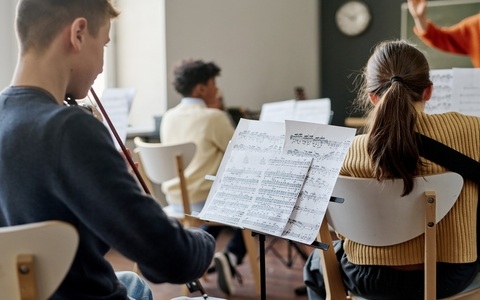
 Studying musical composition as an undergraduate arms you with a foundation in theory, structure, ear training, and other specialized skills that set you apart from self-taught composers in a competitive professional world. Below we walk you through some of the top undergraduate programs for composition, including:
- New England Conservatory: BM – Composition
- Juilliard: BM – Composition
- Curtis Institute of Music: BM – Composition
- University of Southern California’s Thornton School of Music: BM – Composition
- University of Rochester’s Eastman School of Music: BM – Composition
- Northwestern University’s Bienen School of Music: BM – Composition
While these are amongst the top programs in the country for composition, they are by no means the only programs you should consider. Be sure to check out our list at the end of this post, Other Programs of Note, for more exceptional composition programs.
Learning Environment: Conservatory vs. University
Composition students, similar to Music Performance students, should reflect on the differences between conservatories and universities. While conservatories offer classical education with a focus on craft and technique, universities offer students more freedom in terms of genre and area of study. They also require a greater ratio of general education and liberal arts credits than conservatories and will be more flexible with cross-disciplinary study. Universities foster breadth of knowledge whereas conservatories encourage a musical deep dive.
Consider the style of music you want to compose and whether you have a singular focus or broader interests. Classical composition in a conservatory program will emphasize orchestral and chamber music composition whereas schools like Thornton will allow you to study multiple types of composition or experiment with style. Eastman actively asserts: “We have no stylistic or sectarian agendas; our goal is to help students learn to write the music that inspires and interests them.”
Curriculum
Commonalities Amongst Top Programs
Each undergraduate composition program offers a foundational music curriculum including courses in aural training, counterpoint, composition, music theory and music history. Opportunities to have your work performed by other students in your program, which we discuss in more detail below, are also common. At every program featured here (and below under Other Programs of Note) you’ll find award-winning faculty who work with you to distinguish yourself as a composer as well as a plethora of visiting artists, writers and musicians brought to campus to supplement your learning.
Unique Offerings of Top Programs
There are also many ways these programs differ. Let’s first consider the conservatories. Juilliard offers exciting opportunities like ChoreoComp, which pairs dancers and composers to create new works, and Théâter Etudes, a practicum where composers and students from other departments collaborate. NEC is considered more experimental in its approach to conservatory education–with its Integrative Curriculum which situates musical education within a practical context. Curtis has specialized Performance Courses, which allow students the singular focus necessary to improve on their instrument, as well as courses like Major Lessons, where the student meets one-on-one with their major instructor for coaching, including composition coaching. Also unique to Curtis is its Artist Citizen Curriculum, which includes a required course entitled Social Entrepreneurship that connects students with service opportunities in the community. Notably, Curtis offers full-tuition scholarships to all its students.
University programs, like those at Thornton, Eastman and Northwestern, offer similarly distinct and exciting opportunities. Thornton’s Electro-Acoustic curriculum includes courses in Electronic Synthesizer Technique. Students can choose between a degree in Classical Composition or Screen Scoring in their Contemporary Music Department. Thornton’s Contemporary Studies curriculum offers courses like Introduction to Audio Recording & Editing or Basics of the Music Industry.
Eastman and Northwestern both house schools of New Music featuring ensembles as well as the study of contemporary music from the 20th and 21st century. Each university is also equipped with a music library that allows students access to an abundance of music texts and scores from around the world. Northwestern also offers exciting courses such as Phenomenology of Sound, Sound Installation Art, The Art of Noise, and Contemporary Opera, while Eastman rotates its faculty so that each student studies with the same teacher no more than once every three years. These are a few of the unique approaches to composition education that you’ll discover as you continue your research. Which are most important to you?
Location & Culture
Location
Each of the schools we feature in this post is located in an urban environment. Juilliard is in New York City, Thornton in Los Angeles, NEC in Boston, Curtis in Philadelphia, Northwestern in Chicago, and Eastman in Rochester. Be sure to reflect on the pros and cons of each program’s location and whether or not it’s a good fit for you, both personally and professionally.
The city you reside in will influence your professional connections as well as the opportunities to have your music performed outside of your program. Juilliard’s location in NYC has the greatest opportunity for professional networking, in particular with the composers and musicians associated with landmark performance venues such as Carnegie Hall and Lincoln Center (Juilliard students themselves perform or have their music performed at Lincoln Center on occasion). And yet, NYC is competitive and it’s easy to get lost in the bustle.
The other cities on the list have a less competitive environment while still providing opportunities to establish yourself professionally and make connections while you’re in school. Conduct research to find those cultural institutions, performance venues, orchestras, professional composers or music groups that interest you in each city—such as the Boston Chamber Music Society’s Commissioning Club, The Chicago Center for Contemporary Composition, or the Los Angeles Composers Collective. Through these types of organizations you will meet people who will help you begin your career.
Culture
The culture of each program is impacted by the interplay of its size, location, atmosphere, and whether it is a conservatory or university program. Juilliard, like NEC, is known for its rigorous and competitive environment; whereas NEC students feel there is an atmosphere of academic freedom where they can push boundaries and experiment with their work.
The size of the program will also make a difference in its overall culture. Conservatories are more intimate than universities. New England Conservatory and Curtis are two of the smallest with undergraduate enrollment around 100-350. Bienen’s total undergraduate enrollment is around 400 students, while Northwestern as a whole is home to around 9,000 undergraduates.
Though Thornton (like Juilliard) is a mid-sized program compared to Curtis or NEC, with approximately 1,000 undergraduates, its faculty create a personable, welcoming, and supportive environment for students and the atmosphere is less competitive than at the smaller conservatories. Similarly, Eastman’s students love their faculty and feel embraced by a sense of community and a positive learning environment. It enrolls around 500 undergraduates each year, which allows for a relatively intimate and close-knit program. Northwestern and Thornton, like Juilliard, are located in populous, vibrant cities, which bring diversity, energy and intellectualism to the campus cultures.
Performance and Career
Performance Opportunities
Successful composition education involves the opportunity to have your work played by others so that you can listen to it, learn, and revise. Each program offers varying levels of opportunities for your work to be performed.
Juilliard’s program is the most selective where student composers compete throughout the year to have their work chosen for orchestral and chamber music performances at iconic venues such as Alice Tully Hall at Lincoln Center. Eastman’s program, on the other hand, is self-proclaimed as “intense concert life.” It offers myriad opportunities for student performance, including Ossia, a student-run New Music organization and Musica Nova, their New Music Ensemble, as well as readings and performances of student work by the Eastman Symphony and Philharmonia, and faculty commissions.
Thornton emphasizes student composers’ performance opportunities through premieres with Thornton Edge, the school’s new music ensemble, at student recitals and department showcases, as well as its annual New Music for Orchestra concert with the USC Thornton Symphony. Bienen offers 200+ solo and chamber recitals of student work annually as well as three student composer concerts per year. At Curtis, student composers receive a premiere with the Curtis Symphony Orchestra each year alongside its Performance Curriculum (mentioned above) that incorporates weekly one-on-one composition coaching. And finally, NEC offers seven student composer concerts, four orchestral readings, performances by NEC Honors Ensembles and the NEC Contemporary Ensemble, as well as its student-run Tuesday Night Music Series, which regularly performs student composers’ work.
Internships & Professional Development Opportunities
A school’s focus on professional development can also make a significant difference in your success as a composer. These opportunities can take the form of faculty relationships, internships, student organizations, as well as courses and programs that the school offers to help students prepare for their post-graduation life.
You’ll find that courses, even departments, dedicated to professional development are popular in the schools we cover in this series. Thornton, in particular, focuses on career preparation through its Music Mentorship Program and is known for its strong networking opportunities for students post-graduation. Bienen–with its ties to Chicago’s music scene and its 125-person faculty–offers a course entitled Career Preparation: Entering the Music Profession to help students navigate their careers post-graduation. Juilliard’s course, Essentials of Entrepreneurship in the Arts, is a mandatory course that features visits from successful artists and business leaders and teaches students the ins and outs of grant applications, funding, project planning, and budgets. Their Creative Enterprise Initiative also allows students to connect with the broader music community in NYC through excursions, residencies, workshops, and tours. Eastman’s Institute for Music Leadership creates professional development opportunities for its students and alumni, offering career advising and a mentorship program that connects students with industry professionals each semester.
Moreover, professional development can extend beyond the classroom into community work. Curtis integrates its students into the community, requiring them to take a set of courses called Career Studies, which includes Career Guidance Office Hours and Community Artist Fellowships for students to gain an understanding of how to sustain a human-centered approach while serving local communities as musicians and composers. Curtis also offers a wealth of student organizations and activities that connect students with Philadelphia.
NEC connects its students to Boston’s music scene through programs like Boston Bound, a professional development collaboration between NEC students and Boston music organizations. Their student organizations and clubs, such as Musicians for Humanity, help students build relationships in their field that extend beyond the classroom. Additionally, their Entrepreneurial Musicianship Program has in-house career advisors that are conservatory-trained, as well as internship and fellowship opportunities, including with the Boston Chamber Music Society and other professional ensembles and music organizations in the local community.
This is merely an overview of the opportunities these schools offer. Taking the time to consider your prospective schools’ professional development footprint will pay off at the end of your time in the program, when you embark on your new life as a composer.
Conclusion
Ultimately, your top choices for an undergraduate program in composition should reflect a combination of the factors which are most important to you. As a composition student, it is important to be able to have your work performed. Is it more important than prestige? Do you require both? Juilliard will not guarantee as many opportunities to have your work performed as, say, NEC, with its Tuesday Night New Music series, and yet, Juilliard’s opportunities for performance of your work would mean significant and iconic venues. These are the kinds of choices you’ll need to make. As we progress in the series, you’ll learn more about other areas of study and their top programs–many of which also offer degrees in composition, so stay tuned!
Other Programs of Note for Composition
- Boston University College of Fine Arts
- Carnegie Mellon School of Music
- Cornell University College of Arts & Sciences
- Indiana University Jacobs School of Music
- Ithaca College School of Music, Theatre, and Dance
- Rice University, Shepherd School of Music
- Syracuse University, Setnor School of Music
- University of Arizona School of Music
- University of Michigan School of Music, Theatre, and Dance
Feel free to set up a complimentary consultation to learn about our admissions consulting services. Whatever your question, Collegiate Gateway is happy to help!


