
 At Collegiate Gateway, we believe that developing a resume early in your high school career is extremely beneficial. In 9th grade, you can begin maintaining a log of your activities to make note of important information such as the activity and organization name, your role and specific responsibilities, and the duration of your participation. By the end of 10th grade, you can begin to compile that information into a resume. This can help you (and your advisor) evaluate your engagement in activities. Consider the following questions:
- Are there themes of interest that are emerging, such as STEM, the arts, cultural identity, athletics, or community service (to name just a few)?
- Do your activities support your planned academics in college?
- Do you have leadership experience or is there a potential for leadership opportunities in activities that are important to you?
Regularly updating your resume throughout high school will help you preserve the details of your involvement. As an added bonus, you’ll be prepared to apply for internships, employment, and research opportunities as they become available.
As you approach senior year, you can finalize your resume for use in your college applications. Some colleges offer the option to submit a resume as a supplemental component of your application. Since the Common App Activities section only allows for ten activities and a 150-character description for each, submitting a resume can present an opportunity to share more of your experiences and interests with colleges, as well as describe your activities in greater detail. We recommend composing your resume early on in the application process; this will give you a head start on completing the Activities section of the Common Application, prepare you for college interviews, and inspire potential topics and stories for your college essays.
Read on for tips regarding the organization and descriptions of your activities and accomplishments.
How to Select Activities
Before crafting a resume comes the all-important step of doing the extracurricular activities you will include on it! Becoming engaged in activities during high school will strengthen your candidacy as an applicant, as colleges in the U.S. place significant weight on your extracurriculars and community involvement as a measure of your interests, character, and values.
But participating in extracurriculars isn’t just for show; these activities can also help you develop your personal, social, and intellectual skills. And, if you choose wisely, they’re a lot of fun!
Identify Your Interests and Passions. As you consider which activities to get involved in, try to identify your genuine interests and passions. Do you come alive through performing arts? Are you happiest when you’re on the soccer field? Do you love competing in academic settings, like mock trial or debate? Feel free to try out different extracurriculars to see which you enjoy most—a process that you can begin as early as middle school. It’s hard, if not impossible, to know what you like before actually doing it, so take some time to sample various clubs and activities to see what fulfills you most.
Focus on the Most Meaningful Activities. In the end, it’s more rewarding to narrow your commitments down to a few activities that are genuinely meaningful to you than to jump around to as many activities as possible in an effort to impress colleges with quantity over quality. You can (and should!) continue to cultivate new interests throughout high school, but by sticking with a few of these extracurriculars over a longer period of time, you’ll have the opportunity to demonstrate growth on your resume in the form of increased responsibilities and/or leadership positions, such as serving as captain of an athletic team or president of a club.
Develop Depth in Themes of Interest. Think of your interests in terms of themes (like service, sports, research, performing arts, writing and journalism, politics, cultural identity, and advocacy) and aim to develop depth in a few of these areas instead of attempting to be a jack of all trades, master of none.
Organizing Your Resume
Organize your resume by section headers, such as Education, Extracurricular Activities, Community Service, and Work Experience/Internships. Depending on your experiences or specific academic programs you are applying to, you may want to add additional section headers such as Research, Athletics, Performing Arts, Creative Writing, Publications, Entrepreneurship, or Social Justice. At the end of your resume, you can have an Honors and Awards section to list any notable recognitions or achievements. You may also want to consider adding a Skills and Interests section, where you highlight special skills (in areas such as coding or research), language proficiencies, and/or unique interests.
Overall, you should begin your resume with your education section, followed by your most meaningful and current activities and/or employment, ending with activities that you weren’t actively involved in or didn’t participate in recently. When listing your activities, think about most important (and recent) to least important (and least recent).
Resume Writing Tips
Education
- High School: Include expected graduate date (month and year) and any academic honors and awards specific to your high school, if applicable; include GPA and test scores, if strong.
- Summer Educational Programs: Include courses you took for credit or enrichment, along with dates (month and year) and a brief description.
Extracurricular Activities and Employment
- Organization: Sequence your activity categories starting with the most recent and meaningful (those activities that you’ve devoted the most time to and are still involved in) to the least recent/significant. For activities within each category heading, sequence from the most recent to the least recent.
- Format: Bold the title of the activity or organization. If it is outside of your school, include the city and state where the organization is based. Include the grade level(s) during which you were involved in the activity, from lowest to highest, e.g. Grade 9, 10, 11, 12.
- Role/Position: State in italics the position(s) in which you served, such as President, Peer Leader, Researcher, Member. If you’ve held multiple positions, begin with your most recent, e.g. Vice President (12), Member (10-12).
- Description:
- Use bullet points to summarize your responsibilities and accomplishments.
- Order the bullets from most important to least important.
- In the first bullet, describe the objectives of the club or organization if not generally known. (You can combine this with a description of an accomplishment; for example: “Co-launched and edited opinion section and internal blog for national online college guide”)
- Use active verbs to start each bullet, vary your word choice, and omit pronouns (I, we).
- Use the present tense if the activity is ongoing, and past tense if the activity has concluded.
- If applicable, indicate if you were selected or elected to any leadership positions or awarded special recognitions.
- You can repeat honors and awards in an Honors and Awards section at the end of your resume.
- Hours/Week; Weeks/Year: Note that the Common App requires you to enter your time commitment for each of your activities; on a professional-style resume, this information is not necessary.
Summer Activities
- Organization: State the full name of the organization, town, and state.
- Year: Include time period, e.g. June 2016 (4 weeks); hours are not necessary.
How to Submit your Resume to Colleges
Common App Colleges:
Each college that accepts the Common App now has the option to request a resume on their Activities or Writing section, if they so choose. For example, here is what it looks like on Tulane’s application:
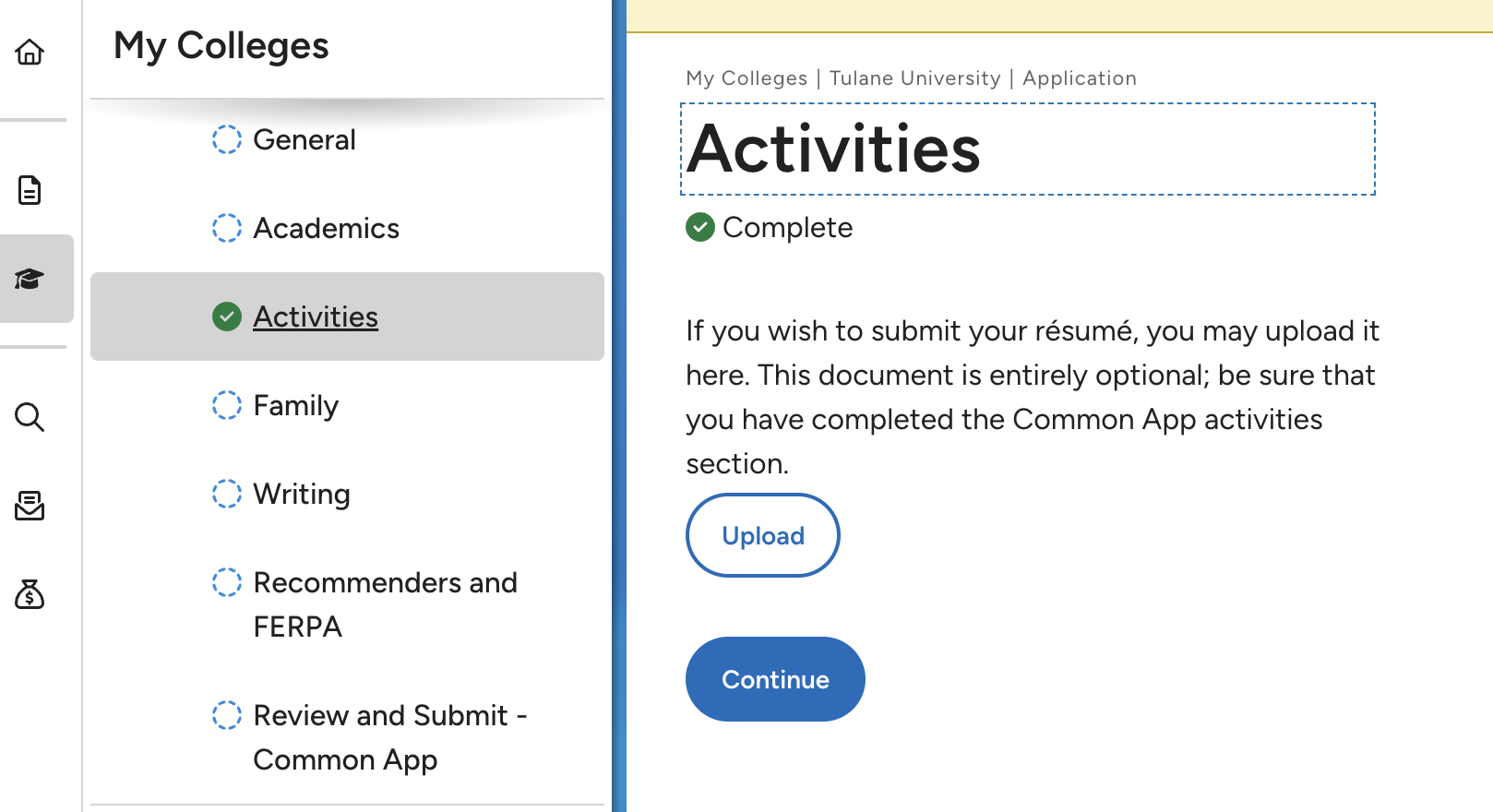
If a college does provide this option, assess whether the Common App Activities section has already adequately summarized your responsibilities. If you feel more detail would be helpful, upload your resume as a PDF.
Non-Common App Colleges:
If colleges with their own applications offer the option to upload a resume instead of completing an Activities section, we recommend doing so since the resume format has more room to include specific details.
Sample Lists of Colleges’ Policies on Including a Resume
Colleges that accept a resume include:
- Barnard College
- Boston College
- Brown University
- Bucknell University
- Claremont McKenna College
- Dartmouth College
- Georgetown University
- Northeastern University
- Northwestern University
- Santa Clara University
- Tulane University
- University of Maryland
- University of North Carolina
- University of Pennsylvania
- UT-Austin
- Vanderbilt University
- Vassar College
- Washington University in St. Louis
Colleges that do not accept a resume include:
- Amherst College
- Brandeis University
- Carnegie Mellon University
- Duke University
- The George Washington University
- Lehigh University
- Massachusetts Institute of Technology
- Pomona College
- Stanford University
- Syracuse University
- Tufts University
- University of Chicago
- University of Michigan
At Collegiate Gateway, we are passionate about helping each student highlight their unique qualities through an effective resume. In addition, we have experience in developing specialized resumes and supplementary materials for students who have special talents in athletics, the arts, or research. For more information, feel free to contact us. We’re always happy to help!