
 In Part Three of our blog series, Crafting Your College List, we’ll help you narrow down the list of schools you will apply to and ensure that your list is balanced in a way that is right for you. The ultimate goal is not only to be accepted, but to succeed and thrive at the college you choose to attend!
See our previous posts in our Crafting Your College List blog series, including Part One, in which we discussed how to identify your Best-Fit College Features; and Part Two, College Visits, which provided tips for researching colleges and making the most of your visits.
Creating Your College List
Assess your candidacy. While your qualitative factors (essays, activities, recommendations, and interviews) can help boost your candidacy, the most important factors in college admission remain the numbers:
- Grades, especially in the core curriculum courses of English, history, foreign language, math, and science;
- Rigor of curriculum, evaluated within the context of what’s offered at your high school;
- Standardized testing, including the ACT or SAT, AP exams, and IB grades, as appropriate. Many schools have adopted a test-optional policy for applicants in recent years, so be sure to check the test score requirements of each of your schools.
Learn about your high school’s admissions history. Secondary schools use web-based software programs like Naviance, Scoir, Xello, and MaiaLearning to present the admissions outcomes of students from their schools based on GPA and test scores. Compare your academic profile with students from your school who have been accepted to colleges in which you are interested.
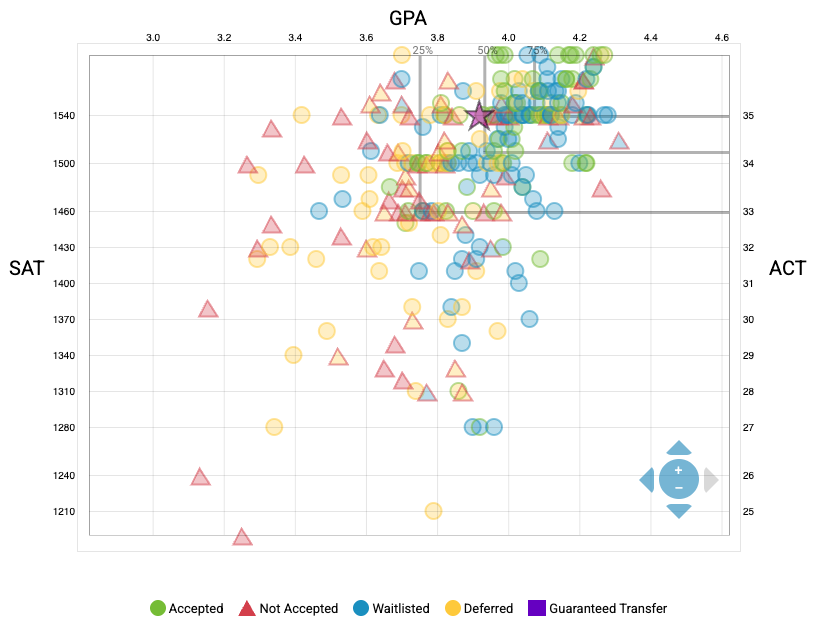
For example, below is a Scoir scattergram of students who applied to the University of Michigan from a private high school in the Bay Area. If you were a student at this high school and your GPA and test scores placed you in the top right of the scattergram, near all the green circles of accepted students, you would have a strong chance of being accepted if you meet Michigan’s other criteria. If your GPA and test scores place you lower and farther to the left, below the icons of accepted students, Michigan may be a reach for you unless you have a strong admissions “hook,” such as being a recruited athlete, underrepresented minority, or first-generation student.
The purple star in the scattergram below represents a student with a 35 ACT and 3.89 GPA. For this student, Michigan would be a target or target/reach school since their GPA and ACT score puts them just below the 50th percentile for accepted students.
Boost your candidacy through your personal factors. Although colleges place significant emphasis on your grades and test scores in their evaluation of your candidacy, qualitative factors have increased in importance over the last decade. In recent years, colleges have become increasingly committed to taking a holistic approach to admissions, as described by Harvard University’s admissions website for first-year applicants:
While academic accomplishment is important, the Admissions Committee considers many other factors—potential contributions to our community, special talents or excellences of all kinds, perspectives formed by life experiences, the willingness to respectfully engage with differing ideas and opinions, and the ability to take advantage of the breadth of Harvard’s resources and opportunities.
Colleges are interested in all the ways that you will contribute to campus life outside the classroom, so it is beneficial in the long run to engage in extracurricular activities that genuinely interest you. These activities can play a positive role in the following aspects of your application:
- Essays and Interviews: you can discuss your involvement in activities in your Personal Essay, supplemental essays, and interviews
- Recommendations: you can ask for letters of recommendation from people outside your academic courses, such as research mentors, coaches, clergy, and supervisors from jobs or internships
Decide on 12-14 colleges to apply to. After carefully considering your “best-fit” college features, and subsequently researching and visiting your colleges, you are ready to narrow down your list. We recommend that your final college list include 12-14 colleges that match your preferences and goals, with a combination of reach, target, and safe schools.
Balance “Reach” With “Realistic”
Consider overall admissions trends. The numbers of students attending college has been steadily increasing since World War II, and after a slight 6% dip from 2010 to 2020, it is on the rise again. In addition, more students are applying to college, and each is applying to an increasing number of colleges. As a result, admissions rates have declined and selectivity has increased. It is more important than ever to have a realistic list.
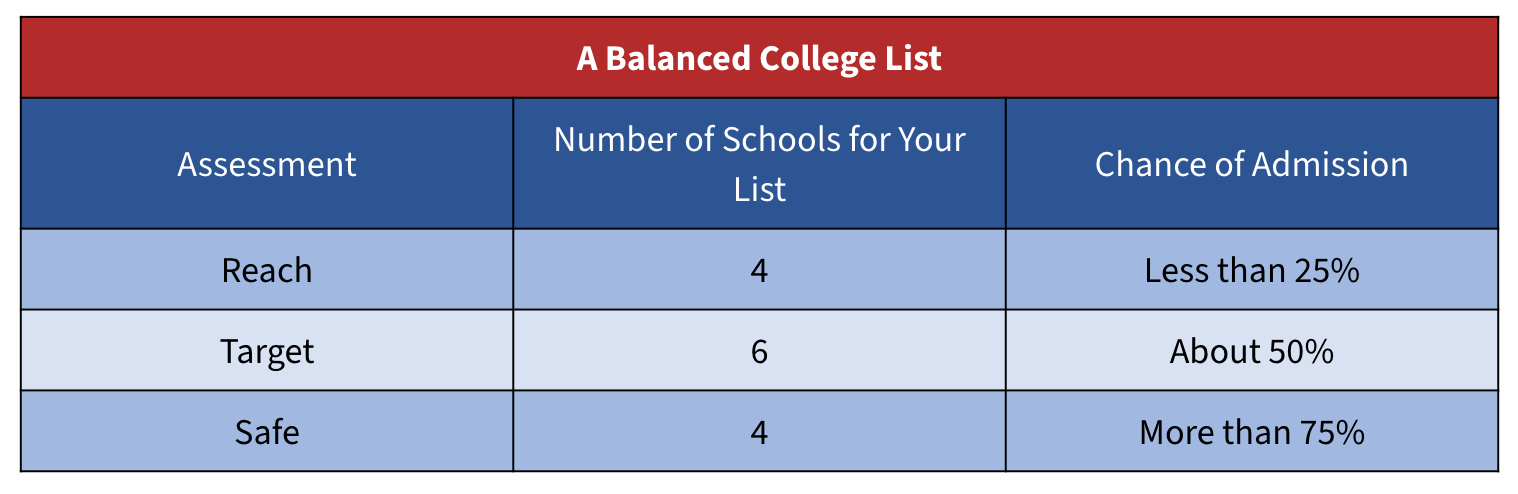
Make sure your college list is balanced. In a typical list of 12-14 colleges, here’s our recommendation for a balance of reach, target, and safe schools:
Tailor your list. Each student’s college list should be suited to their individual academic and personal needs. If you have a strong academic profile and would like a challenging academic environment, it might make sense for you to include more reach schools. If you would like a more manageable course load, you may want to increase the number of safe schools on your list.
Ultimately, your college list should include a range of schools that strike a balance between best-fit and admissibility. As you develop this list and narrow down your selections, we encourage you to refer back to the other two articles in this series — Part One, Best-Fit College Features and Part Two, College Visits.
For further guidance, set up a complimentary consultation to learn about our admissions consulting services. Whatever your question, Collegiate Gateway is happy to help!