
 If you’re at the beginning of the college admissions process, making sense of the various early admissions policies can be overwhelming. This guide will walk you through the types of policies you’ll encounter along the way.
Contact us for a free consultation!
Early admissions policies vary in terms of being binding or non-binding and restrictive or non-restrictive. Let’s start by defining those terms:
Early Decision
Early Decision policies are both binding and restrictive, requiring the applicant to commit to attending if accepted. Applicants may only apply to one school Early Decision, but they are able to submit additional applications to any other non-binding plans, such as Early Action, Regular, or Rolling. Early Decision deadlines are typically November 1 or 15, with decisions being released by mid-December.
Some schools offer a second round, called Early Decision II, which is equally as binding for the applicant, but not as restrictive. With a later deadline of January 1 or 15, applicants would have had the opportunity to submit other early applications in November. A student might choose to apply Early Decision I to their first-choice school and then apply Early Decision II to another top choice if they’ve been denied or deferred at the first school, as either a denial or deferral releases the applicant from binding admission. Decisions for Early Decision II are released by mid-February.
Examples of schools offering Early Decision plans include:

Early Action
The most common (and flexible) of all early application policies, Early Action is neither binding nor restrictive. Applicants can apply to other early admissions colleges, and they are not obligated to accept the offer if admitted. The deadlines are typically November 1 or 15, with decisions being released by mid-December. Early Action II is less common, but still a possibility for some schools; the deadlines vary (December – January), and decisions are released by the end of February.
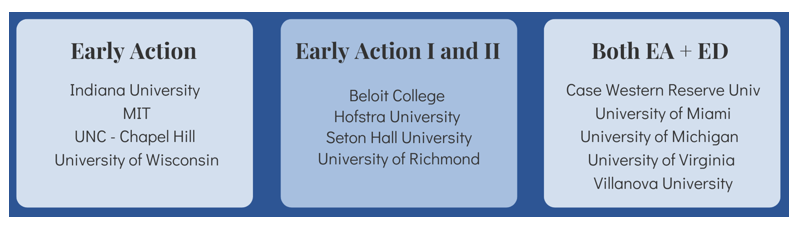
Examples of schools that offer Early Action plans include:
Restrictive or Single-Choice Early Action
Restrictive Early Action (REA) and Single-Choice Early Action (SCEA) are offered by some of the most selective colleges and universities. These plans are not binding – so applicants do not have to attend if accepted – but they do have restrictions on the types of other early applications a student can submit. The deadlines are typically November 1 or 15, and decisions are released by mid-December.
The chart below lists the specific restrictions for each school that offers a REA or SCEA plan.
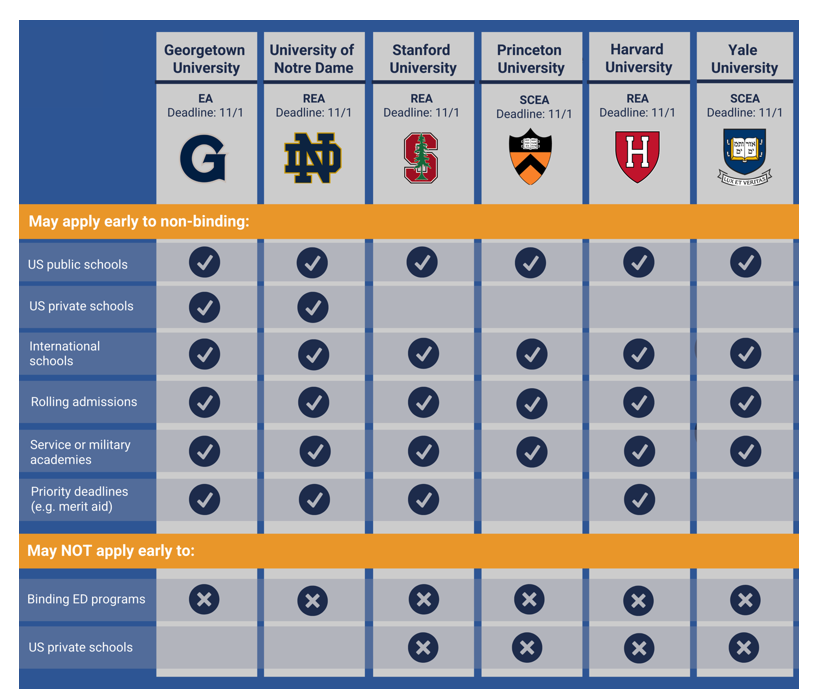
Although restrictive in nature, there is still some flexibility for an applicant to apply to additional colleges when applying Restrictive or Single-Choice Early Action. Here are four possible scenarios:

The college admissions process can be overwhelming, and it may feel difficult to know where to start. At Collegiate Gateway, we are eager to share our expertise and guide you on your admissions strategy and the path to your “best fit” college. Please feel free to contact us! As always, we’re happy to help!