
 Law school admissions has had an eventful couple of decades. Law schools saw a steady increase in their enrollment from 1999 through 2010, but in the following years, as the impact of the recession continued to linger, law schools saw a severe drop in the number of enrollments.
The situation became a downward cycle of cause-and-effect. As fewer students applied, law schools had to compete for a smaller pool of highly qualified applicants. As a result, many schools shrunk their enrollment, worried that if they began accepting less qualified applicants to fill seats, they would jeopardize their rankings.
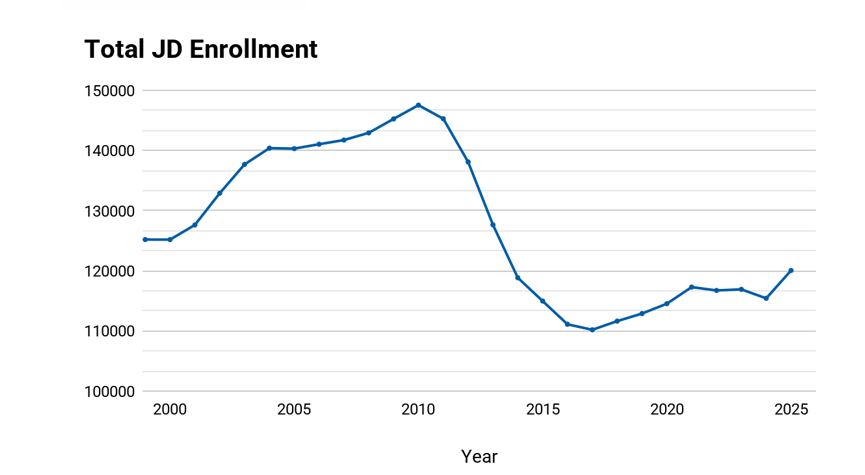
However, since 2018, there have been increases in membership in the American Bar Association (ABA), law school applications, and the number of LSAT registrants. From 2017 to 2018, the ABA reported an 8.1% increase in law school applications, the largest JD programs had seen since 2010. LSAT registrations increased 21.4% that same year. Some refer to this boost in law school interest the “Trump Bump,” because it occurred shortly after the 2016 election. An article by the Chicago Tribune stated that students from across the political spectrum were either being motivated by the newly elected President Trump, or they opposed his policies and saw law school as a way to make a difference.
Following a similar post-election trend, there has been a significant spike in applicants since the 2024 presidential election. Between 2024 and 2025, the number of applicants increased by a whopping 20%, and has only continued to grow; compared to this time last year, there has been a 10% increase in applicants. It will be interesting to follow these trends in the coming years as prospective law students who aspire to serve in government agencies navigate the shifting landscape of legal jobs in the public sector.
Intersection of Artificial Intelligence and Law
Over the past few years, AI has become a prevalent and hotly debated topic, so it should come as no surprise that the legal field is also adapting to the rapid growth of this groundbreaking technology.
According to a 2024 survey by the American Bar Association, 55% of law schools now offer courses specifically related to AI, including classes like Artificial Intelligence, Law, Ethics, and Policy; Electronic Discovery; and Big Tech and the First Amendment. In addition, 93% of law schools surveyed said that they were considering changes to their curriculum based on the increased use of AI in the legal field.
Some law schools are even starting to offer concentrations and/or certificates related to AI and the law. Last year, UC Berkeley Law, which is known for being at the forefront of IP and tech law, began offering an AI Law and Regulation certificate; and beginning this fall, Boston University Law School will offer its own Certificate in AI for Law Practice.
It isn’t just the ethics or regulation of artificial intelligence that is impacting the legal profession – it’s the implementation of it in the work itself. Law firms can use AI to automate the search process, analyze case-related information in the e-discovery process, review contracts for inconsistencies, and more. In 2025, a survey conducted by Bloomberg Law revealed that all but three of the 28 ABA-accredited law schools are now offering courses that teach AI skills.
Although it is still an emerging technology and the full scope of its capabilities and applications is not fully clear yet, recruiters at law firms have already suggested that seeing academic experience related to AI on a resume would be appealing to them as its role in the field is only expected to grow in the coming years.
Our advice, though: Don’t be too quick to focus all your effort into a certain specialty just based on current data. Pick your future career area because you’re passionate about it, regardless of economic trends and fluctuations!
Explore all of our upcoming presentations on our website and connect with us on social media. And as always, please feel free to contact us. We’re happy to help!